Blog
The Hidden Cost of Buying Business Technology
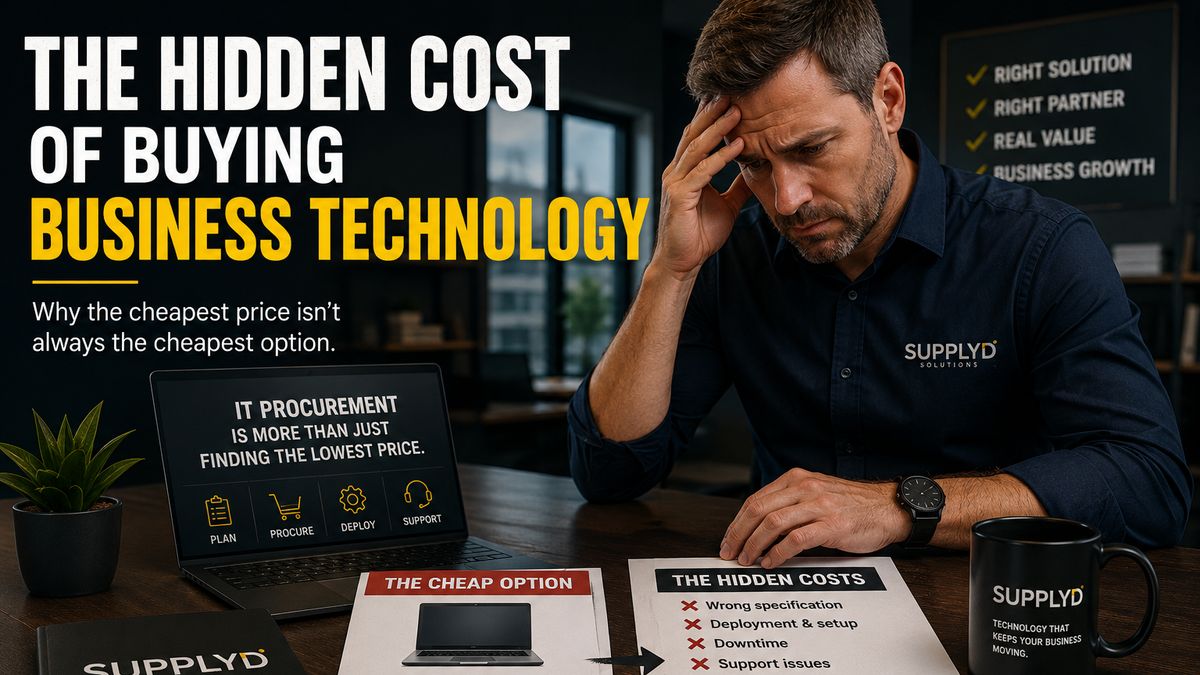
A business needs a new laptop.
Three quotes come in.
The R12,000 option looks like the obvious choice.
Why spend R3,000 more if all three machines appear to do the same thing?
So the business buys the cheapest one.
Six months later, the employee is complaining that the laptop is slow. The software doesn’t run as expected. The machine hasn’t been configured properly. The network setup wasn’t considered. Someone has to spend half a day getting everything working.
Then another employee needs a similar machine.
Then another.
Suddenly, the “saving” doesn’t look quite so impressive.
The problem wasn’t the price of the laptop.
The problem was the decision made before the laptop was purchased.
The price tag isn’t the real cost
This is one of the easiest traps for a business to fall into.
We naturally compare prices because prices are easy to compare.
R12,000 is cheaper than R15,000.
Simple.
But business technology doesn’t operate in isolation.
A laptop, desktop, server, printer, router or software licence has to fit into an existing business environment.
It has to work with the people using it, the software they rely on, the network they connect to and the way the business actually operates.
And that’s where the real cost starts to appear.
1. Buying the wrong specification
The cheapest device isn’t necessarily the right device.
A machine that looks perfectly capable on a supplier’s product page might be completely wrong for the person using it.
An employee working mainly with email and documents has very different requirements from someone working with large spreadsheets, design software, accounting systems or demanding business applications.
Buy too little and you may be replacing the machine sooner than expected.
Buy far more than you need and you’ve spent money that could have been used somewhere else.
Good procurement starts with understanding the requirement before looking for the product.
2. The technology has to fit the business
A piece of technology can be excellent on its own and still be the wrong choice for your business.
A router isn’t just a router.
A laptop isn’t just a laptop.
A printer isn’t just a printer.
A business technology decision needs to consider the environment around it.
- Will it work with your existing network?
- Will your users be able to access what they need?
- Does it fit your security requirements?
- Can it be supported properly?
- Will it integrate with the rest of your technology?
These aren’t questions that appear particularly important when you’re comparing two prices on a spreadsheet.
They become very important when something doesn’t work on Monday morning.
3. Then there is the cost of getting it working
This is one of the costs that often disappears from the original quotation.
The device arrives.
Now what?
Someone has to:
Sometimes that’s straightforward.
Sometimes it isn’t.
And someone’s time has a value.
The R12,000 laptop might still have been cheaper than the R15,000 laptop.
But if the business spends another R3,000 getting it properly deployed and supported, the saving has disappeared.
4. Downtime is an invisible cost
This is where the conversation gets even more interesting.
Imagine an employee earning the business money every day suddenly can’t work because their new computer wasn’t configured correctly.
Maybe it’s only four hours.
Maybe it’s a day.
Maybe the problem affects several employees because the new equipment wasn’t compatible with the existing setup.
You won’t necessarily find “lost productivity” on the original invoice.
But the business still paid for it.
Downtime doesn’t always send you a bill.
Sometimes it simply shows up as work that didn’t get done.
5. Cheap technology can become expensive technology
There is nothing wrong with buying cost-effective technology.
In fact, businesses should absolutely care about what they spend.
The mistake is confusing cheap with good value.
Good value might mean:
- The equipment lasts longer
- It is easier to support
- It meets the actual requirement
- It integrates with existing systems
- It can be upgraded
- It reduces downtime
- It doesn’t need replacing six months later
The cheapest option can be the right option.
But it should be the right option because it makes sense, not simply because the number on the quotation is smaller.
6. Buying from five suppliers can create five different problems
Another common situation looks something like this:
The business buys computers from one supplier.
Networking equipment from another.
Printers from somewhere else.
Software from another company.
And calls a completely different person when something goes wrong.
Each individual purchase might make sense.
But who is looking at the bigger picture?
Who knows why that particular hardware was selected?
Who understands the environment?
Who knows what was installed six months ago?
And when something goes wrong, who is responsible for figuring out where the problem actually sits?
Sometimes the problem isn’t that a business has too many suppliers.
It’s that nobody owns the technology picture.
7. Procurement should start with a question, not a shopping cart
This is probably the biggest lesson.
“How much does this cost?”
“What are we actually trying to achieve?”
If someone needs a new laptop, the first question shouldn’t necessarily be:
“Which laptop is cheapest?”
It should be:
“What does this person need to do every day?”
If the business needs a new network, don’t start with:
“Which router has the best price?”
Start with:
“What does the network need to support?”
If you’re replacing ten computers, don’t simply multiply the cheapest quotation by ten.
Ask:
“Are these ten users actually doing the same thing?”
That’s the difference between buying technology and procuring technology properly.
8. The real procurement process
A better process looks something like this:
Google → Cheapest Price → Buy → Hope.
And yet that’s surprisingly close to how many technology purchases happen.
So what should a business actually look for?
The answer isn’t necessarily the most expensive IT company.
And it isn’t necessarily the cheapest supplier either.
It’s someone who understands that the product is only one part of the decision.
A good technology partner should be willing to ask questions before recommending equipment.
They should understand the environment the equipment is going into.
They should be able to explain why something is being recommended.
And they should be able to tell you when the more expensive option isn’t actually necessary.
Because good procurement isn’t about selling the biggest solution.
It’s about finding the right solution.
And sometimes the answer is: don’t buy anything
This is probably the most uncomfortable thing for a supplier to say.
Sometimes a business doesn’t need another laptop.
It needs the existing machine cleaned up.
Sometimes it doesn’t need a new router.
It needs the network configured properly.
Sometimes it doesn’t need to replace everything.
It needs to understand what is actually causing the problem.
And sometimes the right answer genuinely is:
“Don’t spend the money yet.”
That’s where an independent technology conversation can be worth more than another quotation.
The Supplyd approach
At Supplyd, we look at business technology from both sides.
What does the business need?
And:
What technology will actually solve that requirement?
That can mean sourcing equipment.
It can mean IT support.
It can mean setting up a business network.
It can mean helping with procurement.
And sometimes it simply means helping a business understand what it already has before spending more money.
Because technology should support the business.
The business shouldn’t have to work around the technology.
The R3,000 lesson
Let’s go back to our three laptops.
R12,000.
R13,500.
R15,000.
Maybe the R12,000 laptop was actually the best choice.
Maybe the R15,000 one was.
There isn’t enough information to know.
And that’s exactly the point.
You cannot make a good technology procurement decision from the price alone.
The cheapest quotation might save you R3,000.
Or it might cost you R10,000 later.
The number on the quotation is only the beginning of the calculation.
Before you buy your next piece of business technology
Ask these questions:
- What problem are we actually trying to solve?
- What does the user or business need the technology to do?
- Will it work with what we already have?
- What will it cost to deploy and configure?
- What happens if it fails?
- Who will support it?
- How long do we realistically expect it to last?
- Are we buying the right solution — or simply the cheapest one?
Those questions might save you more money than finding another R500 discount on the quotation.
The bottom line
Business technology isn’t a shopping exercise.
It’s a business decision.
The cheapest laptop isn’t necessarily the cheapest laptop.
The cheapest network isn’t necessarily the cheapest network.
And the cheapest supplier isn’t necessarily the cheapest solution.
Sometimes spending less is the smartest decision.
Sometimes spending more is.
The important part is knowing why.
That’s what good technology procurement should ultimately be about:
Making better decisions before the money leaves the business.
Buy Smart. Buy Once.
Whether you need the right equipment sourced, a business network set up properly, or ongoing IT support — Supplyd looks at the full picture before you spend a cent.
🤖 This article may be AI-assisted and is provided for general information only. Product details, prices, and availability can change — always confirm on the product page before purchasing. See our Terms for details.