Blog
Where Is Your Business Losing Money in Procurement? The Leakage Most Companies Never See
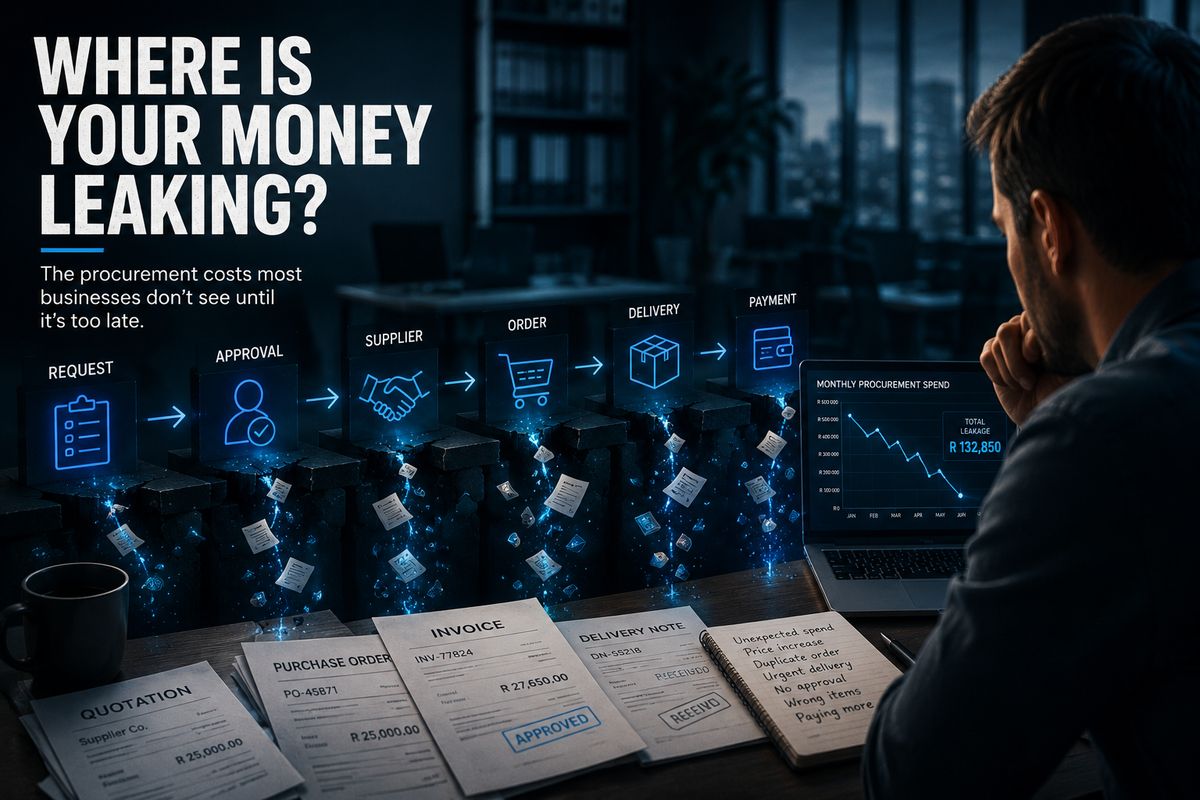
Most businesses know what they spend. Far fewer know where the money leaks.
Ask a business owner how much their company spent last month and, assuming the accounts are reasonably organised, they can probably give you an answer.
Now ask a different question:
How much of that spending could have been avoided, challenged, negotiated, approved differently or caught before payment?
That’s where things get interesting.
Because knowing what you spent isn’t the same as knowing whether you spent it well.
This is where procurement leakage enters the picture.
And procurement leakage doesn’t necessarily mean somebody is stealing from the business.
It can be something much less dramatic:
One of these might barely register.
Hundreds of them over a year can become a very different story.
What is procurement leakage?
Procurement leakage is the gap between what a business intended to spend and what it actually ends up spending.
That gap can appear anywhere in the procurement journey.
A typical purchase might look straightforward:
But every stage creates an opportunity for something to go wrong.
And if those steps aren’t connected, the business may only discover the difference after the money has already left.
Procurement leakage isn’t always fraud
This distinction matters.
When businesses hear terms like procurement leakage, spend control or procurement risk, the conversation can immediately become uncomfortable.
But leakage doesn’t automatically mean fraud.
It can happen because of ordinary business behaviour.
None of these necessarily involves bad intentions.
They’re often simply process problems.
And process problems cost money.
The spreadsheet isn’t necessarily the problem
Spreadsheets are useful.
So are email, accounting software, WhatsApp and shared documents.
The problem comes when a business uses several disconnected tools to manage one connected process.
Imagine a purchase like this:
Every individual step happened.
But where is the complete record?
Who can easily answer:
What was originally requested, who approved it, what was quoted, what was ordered, what arrived and what was eventually paid?
If nobody can answer that quickly, you don’t necessarily have a spending problem.
You have a visibility problem.
The question businesses should be asking
Most businesses ask:
How much did we spend?
That’s important.
But it’s only the first question.
A better question is:
Did we spend the money the way we intended to?
And an even better one:
Where did the actual transaction differ from what was requested, approved, ordered and delivered?
That’s where procurement control starts becoming meaningful.
Because you can’t control what you can’t see.
Where does procurement leakage hide?
Let’s take something simple: a business needs five laptops.
The requirement is submitted.
The purchase is approved.
A supplier provides a quotation.
The order is placed.
The laptops arrive.
The invoice is paid.
Looks straightforward.
But now look closer.
There doesn’t have to be a villain in this story.
The process simply didn’t connect the dots.
That’s procurement leakage.
The hidden cost of “just get it done”
Urgency is expensive.
A laptop fails.
A network goes down.
A printer stops working.
A production requirement suddenly appears.
A customer needs something tomorrow.
Someone says:
“Just get it sorted.”
So somebody finds a supplier, gets a price and buys it.
The immediate problem is solved.
But if that becomes the normal way of buying, the business starts losing opportunities to:
Speed has value.
But uncontrolled speed has a cost.
Procurement control shouldn’t slow your business down
Good procurement isn’t about creating bureaucracy for the sake of bureaucracy.
You don’t need six approval stages to buy a keyboard.
The objective is appropriate control around meaningful expenditure.
A good procurement process should make it possible to answer:
And perhaps most importantly:
Can we prove what happened?
That’s procurement visibility.
What happens when a business grows?
Small businesses can often manage procurement informally.
The owner knows what is happening.
Everyone sits close together.
There may only be five or ten regular suppliers.
But growth changes things.
Suddenly there are:
The informal system that worked for a small business doesn’t necessarily survive growth.
And that’s where things become interesting.
The business hasn’t necessarily created a bad procurement process.
The business simply outgrew it.
The problem isn’t always that you’re spending too much
This is an important distinction.
The objective of procurement isn’t:
Spend as little as possible.
It’s:
Spend intentionally.
The cheapest laptop isn’t necessarily the best purchase.
The cheapest supplier isn’t necessarily the best supplier.
The cheapest option today can create higher costs tomorrow through downtime, poor quality, replacement costs or unreliable delivery.
Good procurement considers:
That’s why simply looking for the cheapest quotation isn’t procurement strategy.
It’s shopping.
So how do you know if your business has procurement leakage?
Start with your last 20–50 purchases.
Pick purchases across different categories rather than only looking at one supplier.
Then compare:
Now look for the gaps.
You may find nothing.
That’s good.
Or you may discover patterns you didn’t know existed.
That’s even more useful.
Because finding a problem is the first step toward controlling it.
A simple procurement leakage checklist
Ask yourself:
- Do we know exactly where our procurement spend is going? Not just the total — but by supplier, category, department and type of purchase.
- Are purchases approved before they’re made? Or do approvals sometimes happen afterwards?
- Do employees know which suppliers they should use?
- Can we identify duplicate purchases?
- Can we compare quoted prices with actual purchase prices?
- Do we verify deliveries before paying?
- Can we trace a purchase from request through to payment?
- Can management identify unusual spending patterns?
- Do we have an audit trail?
- If somebody questioned a purchase six months from now, could we show exactly what happened?
If several answers are “no”, you may have a procurement control gap.
And that’s worth investigating.
Before buying software, understand the problem
This is where many businesses get it backwards.
They recognise that procurement is messy.
Then they search for procurement software.
Then they buy a platform.
Then they discover that their underlying process is still unclear.
Technology doesn’t automatically fix procurement.
Good procurement technology should support a good process, not hide a broken one.
Before buying anything, understand where your current controls are strong and where they’re weak.
That’s why we built the SpendVault Procurement Leakage Check
At Supplyd, we’ve spent years dealing with technology purchasing and the practical problems businesses encounter around procurement.
One of the recurring problems isn’t necessarily a lack of spending data.
It’s a lack of connected visibility.
That’s why we built SpendVault.
And before asking a business to buy procurement software, we think there’s a more important question:
Where are your procurement controls today?
So SpendVault offers a free AI-guided Procurement Leakage Check for South African SMEs.
The audit looks at key control areas including:
It covers 17 procurement control checks and produces a control score and practical findings. The process is designed to take roughly five minutes.
Find the gaps before the money leaves.
Find the gaps before the money leaves.
SpendVault’s free Procurement Leakage Check takes roughly five minutes and evaluates 17 procurement control checks across key areas of the purchasing process, producing a control score and practical findings.
There’s no need to start by buying software.
Start by finding out where your controls stand.
What does the free audit actually give you?
The purpose isn’t to accuse your employees, suppliers or finance team of doing something wrong.
It’s to identify control gaps and exposure areas.
The audit uses your answers to build a structured picture of how requests, suppliers, deliveries, stock and payment evidence move through your business. It then turns that information into a control score and practical findings.
The SpendVault audit is explicitly designed as an assessment of procurement controls — not a legal finding or an accusation of fraud.
That’s important.
Because the objective isn’t to point fingers.
It’s to find the gaps before they become expensive.
What if your score isn’t great?
That’s actually useful.
A low control score doesn’t mean your business is badly run.
It means you’ve identified areas where the procurement process could be stronger.
Perhaps approvals are inconsistent.
Perhaps supplier verification needs work.
Perhaps delivery evidence isn’t always captured.
Perhaps invoices aren’t consistently matched against orders and deliveries.
Perhaps management doesn’t have enough visibility over spending.
Now you have something concrete to work on.
And that’s far more useful than simply saying:
“We probably need better procurement.”
The bigger opportunity: moving from reactive to controlled procurement
There’s a fundamental difference between these two approaches.
Someone needs something.
A purchase is made.
An invoice arrives.
Accounts pays it.
Management sees the expenditure later.
The purchase is evaluated.
The appropriate person approves it.
The supplier and price are known.
The order is recorded.
The delivery is verified.
The invoice is matched.
The transaction is traceable.
Neither system guarantees perfection.
But the second gives the business something extremely valuable:
Visibility before, during and after the spend.
And this matters even more for South African SMEs
Large organisations may have procurement departments, purchasing teams, approval committees and dedicated systems.
Smaller businesses often don’t.
The same person might be responsible for operations, purchasing and supplier relationships.
Someone in finance handles payment.
An employee handles the request.
The owner approves larger purchases.
That doesn’t mean an SME needs enterprise-level bureaucracy.
It means the business needs simple controls that people will actually use.
The right procurement process should make good purchasing easier, not harder.
The uncomfortable question
Here’s the question I’d ask if I owned a growing business:
If I looked at every purchase my business made over the last 12 months, would I be comfortable defending every rand?
Not just:
Did we need it?
But:
If you can’t answer those questions, don’t immediately assume your business has a serious procurement problem.
But recognise something important:
You may not have enough visibility to know whether you do.
And that can be the bigger problem.
Find the gaps before the money leaves
You don’t need to start by buying a procurement platform.
You don’t need to completely redesign your purchasing process.
And you certainly don’t need to assume someone is doing something wrong.
Start with visibility.
SpendVault’s free Procurement Leakage Check takes roughly five minutes and evaluates 17 procurement control checks across key areas of the purchasing process, producing a control score and practical findings.
Find the gaps before the money leaves.
Where do your procurement controls stand today?
Run the free Procurement Leakage Check and get a control score and practical findings in roughly five minutes — no software purchase required.
Final thought
Businesses rarely lose significant amounts of money through one enormous procurement mistake.
More often, it’s a collection of small decisions.
A slightly higher price.
An unnecessary urgent purchase.
A duplicate order.
An uncontrolled supplier.
A missed approval.
A delivery that wasn’t properly checked.
A recurring expense nobody questioned.
One isn’t necessarily significant.
Hundreds are.
That’s why procurement control isn’t about watching every rand.
It’s about building enough visibility to know:
Where is the money going?
Why is it going there?
Was it approved?
Did we receive what we paid for?
And could we have made a better decision?
Because sometimes the biggest procurement saving isn’t finding a cheaper supplier.
It’s discovering the leakage you didn’t know you had.
Want to go deeper on the money side of buying for your business? This related read pairs well:
- The Hidden Cost of Buying Business Technology — why the sticker price is rarely the whole price when your business buys technology.
🤖 This article may be AI-assisted and is provided for general information only. Product details, prices, and availability can change — always confirm on the product page before purchasing. See our Terms for details.